Published
2026-02-11
Issue
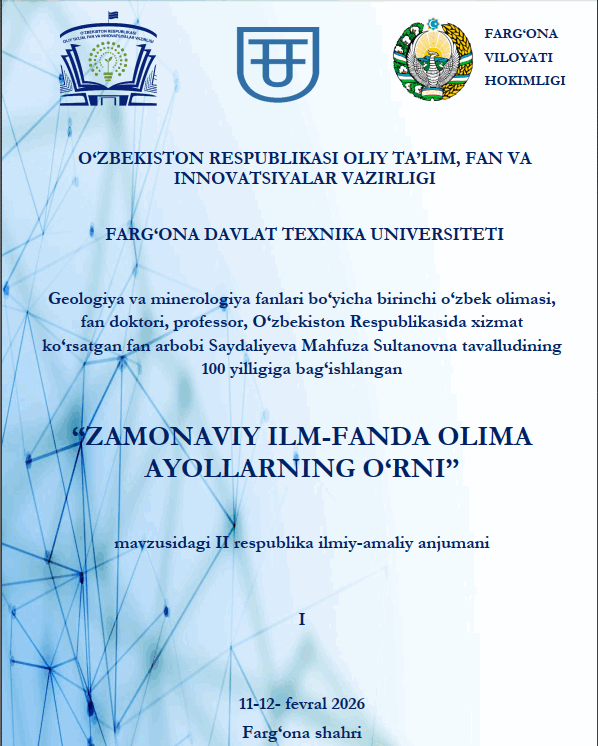
2026: “Zamonaviy ilm-fanda olima ayollarning o‘rni” mavzusidagi II respublika ilmiy-amaliy anjumani
Section
Articles

How to Cite
ZAMONAVIY JAMIYATDA ILM-FAN VA OLIMA AYOL FENOMENI
O. A. Islomova
Farg‘ona davlat universiteti
Abstract
Annotatsiya. Mazkur tezisda zamonaviy jamiyat sharoitida ilm-fan va ayol olima fenomeni sotsiologik yondashuv asosida tahlil qilinadi. Jamiyatimizda ayol olimalarning ilmiy faoliyatdagi ishtiroki, ularning jamiyat intellektual salohiyatini oshirishdagi o‘rni hamda ilmiy institutlar doirasida yuzaga kelayotgan ijtimoiy omillarni sotsiologik hihatdan baholash davrning dolzarb vazifalaridaan biridir. Tezisda ilm-fan sohasida ayol olimalarning faolligiga ta’sir etuvchi institutsional, madaniy va gender omillari tahlil qilinib, zamonaviy tendensiyalar asosida baholanadi. Maqolada ayol olima fenomeni nafaqat gender tengligi masalasi, balki ilmiy innovatsiyalar va jamiyat barqaror rivojlanishining muhim omili sifatida talqin etiladi. Tadqiqot natijalari ilm-fan va ta’lim tizimida ayollar ishtirokini kengaytirishga qaratilgan ilmiy-amaliy xulosalar chiqarish imkonini beradi.
Kalit so‘zlar: ilm-fan, ayol olima, gender tengligi, fan sotsiologiyasi, ilmiy faoliyat, zamonaviy jamiyat, ilmiy institutlar, intellektual salohiyat
Abstract.This thesis analyzes the phenomenon of science and women scientists in the context of modern society from a sociological perspective. The participation of women scientists in scientific activity, their role in enhancing the intellectual potential of society, as well as the social factors emerging within scientific institutions are among the most pressing issues of our time and are sociologically evaluated in this study. The thesis examines institutional, cultural, and gender factors influencing the scientific activity of women scientists and assesses them based on contemporary trends. The article interprets the phenomenon of women scientists not only as an issue of gender equality, but also as an important factor in scientific innovation and sustainable development of society. The research findings provide an opportunity to draw scientific and practical conclusions aimed at expanding women’s participation in science and education systems.
Keywords: science, woman scientist, gender equality, sociology of science, scientific activity, modern society, scientific institutions, intellectual potential
Аннотация. В данной статье с социологической точки зрения анализируется феномен науки и женщины-учёного в условиях современного общества. Участие женщин-учёных в научной деятельности, их роль в повышении интеллектуального потенциала общества, а также социальные факторы, формирующиеся в рамках научных институтов, являются одними из наиболее актуальных задач современности и подвергаются социологической оценке. В тезисе анализируются институциональные, культурные и гендерные факторы, влияющие на научную активность женщин-учёных, и даётся их оценка на основе современных тенденций. Феномен женщины-учёного рассматривается не только как проблема гендерного равенства, но и как важный фактор научных инноваций и устойчивого развития общества. Результаты исследования позволяют сформулировать научно-практические выводы, направленные на расширение участия женщин в науке и системе образования.
Ключевые слова: наука, женщина-учёный, гендерное равенство, социология науки, научная деятельность, современное общество, научные институты, интеллектуальный потенциал
References
1. Абдурахманова, Г. (2021). Илм-фан ва гендер тенглиги масалалари. Ижтимоий фанлар журнали, 3(2), 45–52.
2. Каримова, М. (2020). Аёлларнинг илмий фаолияти ва жамият тараққиёти. Тошкент: Фан ва технологиялар нашриёти.
3. Назарова, Ш. (2019). Гендер тадқиқотларининг социологик асослари. Социология масалалари, 4, 60–67.
4. Bourdieu, P. (2004). Science of Science and Reflexivity. Chicago: University of Chicago Press.
5. Connell, R. (2012). Gender and Power: Society, the Person and Sexual Politics. Cambridge: Polity Press.
6. Harding, S. (2016). Whose Science? Whose Knowledge? Thinking from Women’s Lives. New York: Cornell University Press.
7. Merton, R. (1973). The Sociology of Science: Theoretical and Empirical Investigations. Chicago: University of Chicago Press.
8. Oakley, A. (2015). Sex, Gender and Society. London: Routledge.
9. UNESCO. (2022). Women in Science: Facts and Figures. Paris: UNESCO Publishing.
10. World Economic Forum. (2023). Global Gender Gap Report. Geneva: WEF.