Published
2026-02-11
Issue
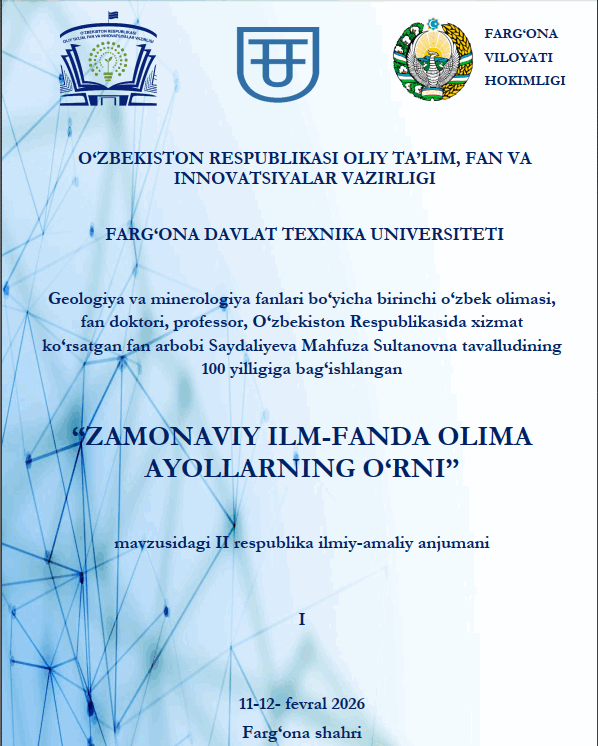
2026: “Zamonaviy ilm-fanda olima ayollarning o‘rni” mavzusidagi II respublika ilmiy-amaliy anjumani
Section
Articles

How to Cite
DEVELOPING LEARNERS’ LANGUAGE SKILLS THROUGH MODERN PEDAGOGICAL TECHNOLOGIES AND ARTIFICIAL INTELLIGENCE
S.A. Mavlonova
Termez State Pedagogical University
Abstract
Abstract. This article explores the role of modern pedagogical technologies and artificial intelligence in developing learners’ language skills. The study focuses on the application of artificial intelligence–based tools in language education and their impact on improving learners’ linguistic competence. Modern pedagogical technologies support learner-centered and personalized instruction, enhancing motivation and engagement in the learning process. The article concludes that the integration of artificial intelligence into language teaching significantly contributes to the effectiveness and quality of language education.
Аннотация. В данной статье рассматривается роль современных педагогических технологий и искусственного интеллекта в развитии языковых навыков обучающихся. Исследование сосредоточено на применении инструментов, основанных на искусственном интеллекте, в языковом образовании и их влиянии на формирование языковой компетенции обучающихся. Современные педагогические технологии поддерживают личностно-ориентированное и персонализированное обучение, повышая мотивацию и вовлечённость в учебный процесс. В статье делается вывод о том, что интеграция искусственного интеллекта в процесс обучения языкам способствует повышению эффективности и качества языкового образования.
Annotatsiya. Mazkur maqolada zamonaviy pedagogik texnologiyalar va sun’iy intellektning o‘quvchilarning til ko‘nikmalarini rivojlantirishdagi o‘rni yoritilgan. Tadqiqotda sun’iy intellektga asoslangan vositalarning til ta’limida qo‘llanilishi hamda ularning o‘quvchilarning til kompetensiyasini shakllantirishga ta’siri tahlil qilingan. Zamonaviy pedagogik texnologiyalar shaxsga yo‘naltirilgan va individuallashtirilgan ta’limni qo‘llab-quvvatlab, o‘quvchilarning motivatsiyasi va faolligini oshiradi. Maqolada sun’iy intellektni til o‘qitish jarayoniga integratsiya qilish til ta’limining samaradorligi va sifatini oshirishga xizmat qilishi xulosalanadi.
Kalit so‘zlar: Sun’iy intellekt, Zamonaviy ta’lim, O‘rganuvchilar learners, Raqamli ta’lim texnologiyalari, Individual ta’lim, Moslashuvchan o‘qitish, Ta’limda innovatsiyalar, Mustaqil ta’lim, Tanqidiy fikrlash, Ta’lim sifati.
Key words: Artificial Intelligence, Modern Education, Learners, Digital Learning Technologies, Personalized Learning, Adaptive Learning, Educational Innovations, Independent Learning, Critical Thinking, Quality of Education.
Ключевые слова: Искусственный интеллект, Современное образование, Обучающиеся, Цифровые образовательные технологии, Персонализированное обучение, Адаптивное обучение, Образовательные инновации, Самостоятельное обучение, Критическое мышление, Качество образования.
References
1. Almutairi, H. N., Al-Osail, A. F., Alshehri, M. A., Mohammed, M. A. E., Al-Dosari, M. N. A., Nemt-allah, M. A., & Abdellatif, M. A. (2025). The impact of AI-enhanced educational technologies on English language learning and reading comprehension: Towards individualized future education. Research Journal in Advanced Humanities, , 1–17. https://doi.org/10.58256/03h3er30
2. Fitas, R. (2025). Inclusive English education with AI: Supporting learners with low proficiency and tackling language barriers. AI and Ethics, 5729–5757. https://doi.org/10.1007/s43681-025-00824-3
3. Kuerban, Y., Oyelere, S. S., & Sanusi, I. T. (2025). ReadSmart: Generative AI and augmented reality solution for supporting English language learners with reading difficulties. International Journal of Technology in Education and Science, 159–176. https://doi.org/10.46328/ijtes.599
4. Ramasamy, J. V., Yunus, M. M., & Ismail, H. H. (2025). Effectiveness of Google Read-Along application in improving English reading skills of upper-primary ESL learners. International Journal of Academic Research in Progressive Education and Development, 2188–2212. https://doi.org/10.6007/IJARPED/v14-i1/24948
5. Silor, A. C., & Silor, F. S. C. (2025). Boosting English reading comprehension through AI-based real-time translation tools. International Journal of Learning, Teaching and Educational Research, 61–79. https://doi.org/10.26803/ijlter.24.9.4
6. Islomov, M. R., & Abdurahmonova, G. S. (2022). Application of artificial intelligence technologies in English language reading instruction in Uzbekistan. Tashkent State 45–52. http://journal.tsue.uz/index.php/pedagogics/article/view/1325
7. Shokirova, D. K., & Kadirova, M. M. (2023). The use of AI-based feedback and real-time translation tools to improve students’ English reading motivation. Journal of Innovative Pedagogy, 101–108. https://doi.org/10.5281/zenodo.7543216
8. Abdullaeva, Z. N. (2021). Digital technologies in English learning in Uzbekistan: Role of AI tools in enhancing reading fluency and comprehension. Uzbek Journal of Education and Science, 84–89. https://uzj-es.uz/index.php/archive/article/view/221
9. Nazarov, A. A., & Tursunova, D. R. (2023). Adaptive AI-supported learning platforms for low-proficiency English learners: Evidence from secondary schools in Uzbekistan. In Proceedings of the Republican Scientific-Practical Conference on Digital Education, 35–42. http://conference.moedu.uz/digitallearning/2023/3nazarov