Published
2026-02-11
Issue
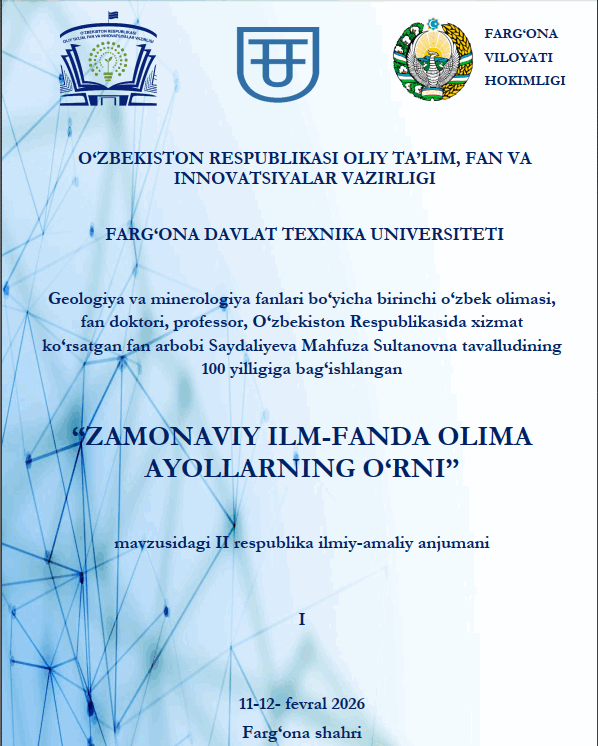
2026: “Zamonaviy ilm-fanda olima ayollarning o‘rni” mavzusidagi II respublika ilmiy-amaliy anjumani
Section
Articles

How to Cite
OLIY TA’LIM MUASSASALARIDA FIZIKA FANINI O‘QITISHDA ZAMONAVIY INTERAKTIV USULLARDAN FOYDALANISH
M.A. Yusupova
Andijon davlat tibbiyot instituti
Abstract
Annotatsiya. Mazkur ilmiy maqolada oliy ta’lim muassasalarida fizika fanini o‘qitish jarayonida zamonaviy interaktiv ta’lim usullaridan foydalanishning pedagogik, metodik va didaktik asoslari kompleks tahlil qilinadi. Raqamli transformatsiya sharoitida fizika ta’limi mazmunini yangilash, talabalarning o‘quv-bilish faolligini oshirish, nazariy bilimlarni amaliy faoliyat bilan integratsiyalash hamda ularning kasbiy va ilmiy kompetensiyalarini shakllantirishda interaktiv metodlarning ahamiyati asoslab beriladi. Tadqiqot doirasida muammo asosida o‘qitish (PBL), teskari sinf modeli, virtual laboratoriyalar, raqamli simulyatsiyalar, kollaborativ ta’lim hamda sun’iy intellektga asoslangan adaptiv ta’lim tizimlarining ta’lim samaradorligiga ta’siri ilmiy jihatdan yoritiladi. Tadqiqot natijalari zamonaviy interaktiv metodlar fizika fanini o‘qitishda talabalarning motivatsiyasini oshirish, nazariya va amaliyot uyg‘unligini ta’minlash hamda ta’lim sifatini yaxshilashga xizmat qilishini ko‘rsatadi.
Kalit so‘zlar: fizika ta’limi, interaktiv metodlar, oliy ta’lim, raqamli transformatsiya, virtual laboratoriyalar, raqamli simulyatsiyalar, kollaborativ ta’lim, adaptiv ta’lim tizimlari, sun’iy intellekt.
Abstract. This scientific article provides a comprehensive analysis of the pedagogical, methodological, and didactic foundations of applying modern interactive teaching methods in physics education at higher education institutions. In the context of digital transformation, the significance of interactive approaches in updating the content of physics education, increasing students’ cognitive engagement, integrating theoretical knowledge with practical activities, and developing their professional and scientific competencies is substantiated. The study examines the effectiveness of problem-based learning (PBL), flipped classroom models, virtual laboratories, digital simulations, collaborative learning, and artificial intelligence-based adaptive learning systems from a scientific perspective. The findings demonstrate that modern interactive methods play a crucial role in enhancing student motivation, ensuring the integration of theory and practice, and improving the overall quality of physics education.
Keywords: physics education, interactive teaching methods, higher education, digital transformation, virtual laboratories, digital simulations, collaborative learning, adaptive learning systems, artificial intelligence.
References
1. Prince, M. (2004). Does active learning work? A review of the research. Journal of Engineering Education, 93(3), 223–231. https://doi.org/10.1002/j.2168-9830.2004.tb00809.x. https://www.academia.edu/search?q=Does%20active%20learning%20work%20Prince
2. Freeman, S., Eddy, S. L., McDonough, M., Smith, M. K., Okoroafor, N., Jordt, H., & Wenderoth, M. P. (2014). Active learning increases student performance in science, engineering, and mathematics. Proceedings of the National Academy of Sciences, 111(23), 8410–8415. https://doi.org/10.1073/pnas.1319030111. https://www.academia.edu/search?q=Active%20learning%20increases%20student%20performance
3. Hake, R. R. (1998). Interactive-engagement versus traditional methods: A six-thousand-student survey of mechanics test data for introductory physics courses. American Journal of Physics, 66(1), 64–74. https://doi.org/10.1119/1.18809
https://www.academia.edu/search?q=Interactive-engagement%20versus%20traditional%20methods%20Hake
4. Mukhammadjonovich, R. M., Abdulkhamidovna, I. A., Abdumukhtorovich, G. S., Abdusaitovich, T. O., & Sobirovich, K. S. (2023). Use of new innovative methods in teaching the science of information technologies and modeling of technological processes. Journal of Survey in Fisheries Sciences, 10(2S), 1458-1463