Published
2026-02-11
Issue
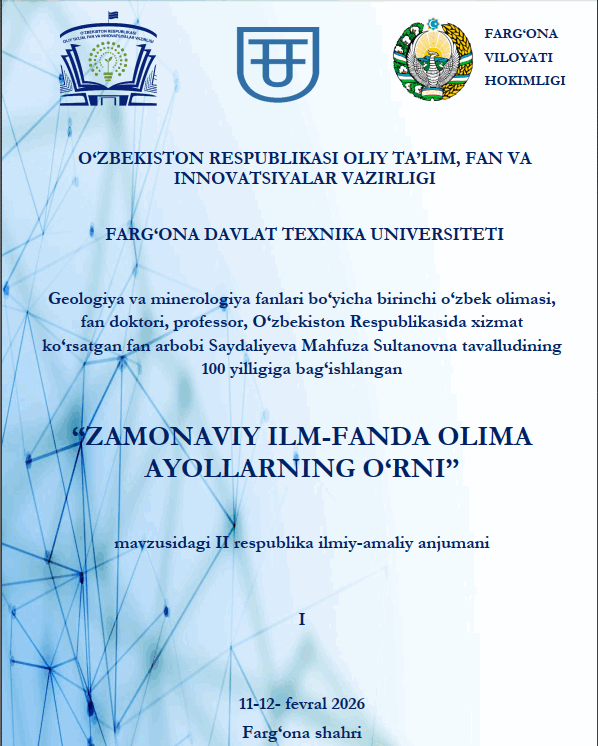
2026: “Zamonaviy ilm-fanda olima ayollarning o‘rni” mavzusidagi II respublika ilmiy-amaliy anjumani
Section
Articles

How to Cite
АНАЛИЗ СОДЕРЖАНИЯ СПЕЦ-ДИСЦИПЛИН В ТЕХНИЧЕСКОМ ВУЗЕ С ТОЧКИ ЗРЕНИЯ РАЗВИТИЯ СИСТЕМНОГО МЫШЛЕНИЯ
Юсупова Л.Ф.
Андижанский государственный технический институт
Abstract
Аннотация. В условиях цифровизации и усложнения инженерной деятельности особую значимость приобретает развитие системного мышления у студентов технических вузов. В статье представлен анализ содержания специальных дисциплин инженерного профиля с точки зрения их потенциала формирования системного мышления. Рассматриваются ключевые структурные элементы учебных курсов, включая междисциплинарные связи, иерархию понятий, моделирование технических систем и ориентацию на решение комплексных профессиональных задач. Показано, что традиционное предметно-фрагментарное построение спецдисциплин ограничивает возможности формирования целостного системного видения. Обосновывается необходимость целенаправленной трансформации содержания специальных дисциплин на основе принципов системного подхода, интеграции теоретических и прикладных компонентов, а также использования проблемно-ориентированных и проектных методов обучения.
Ключевые слова: системное мышление; специальные дисциплины; технический вуз; инженерное образование; междисциплинарная интеграция; системный подход; содержание обучения
Abstract. In the context of digitalization and the increasing complexity of engineering activities, the development of systems thinking in students at technical universities is particularly important. This article presents an analysis of the content of specialized engineering disciplines in terms of their potential for developing systems thinking. Key structural elements of the courses are considered, including interdisciplinary connections, conceptual hierarchy, modeling of technical systems, and a focus on solving complex professional problems. It is shown that the traditional subject-based, fragmented structure of specialized disciplines limits the ability to develop a holistic systems vision. The article substantiates the need for a targeted transformation of the content of specialized disciplines based on the principles of a systems approach, the integration of theoretical and applied components, and the use of problem-based and project-based teaching methods.
Keywords: systems thinking; specialized disciplines; technical university; engineering education; interdisciplinary integration; systems approach; learning content
Annotatsiya. Raqamlashtirish va muhandislik faoliyatining murakkablashuvi sharoitida texnik universitetlar talabalarida tizimli fikrlashni rivojlantirish ayniqsa muhimdir. Ushbu maqolada ixtisoslashgan muhandislik fanlari mazmunining tizimli fikrlashni rivojlantirish potentsiali nuqtai nazaridan tahlili keltirilgan. Kurslarning asosiy tarkibiy elementlari, jumladan, fanlararo aloqalar, kontseptual ierarxiya, texnik tizimlarni modellashtirish va murakkab professional muammolarni hal qilishga e'tibor qaratiladi. Ixtisoslashgan fanlarning an'anaviy fanga asoslangan, parchalanib ketgan tuzilishi yaxlit tizimli qarashni rivojlantirish imkoniyatini cheklashi ko‘rsatilgan. Maqolada tizimli yondashuv tamoyillari, nazariy va amaliy komponentlarni integratsiyalash va muammoli va loyihaga asoslangan o‘qitish usullaridan foydalanish asosida ixtisoslashgan fanlar mazmunini maqsadli ravishda o‘zgartirish zarurati asoslanadi.
Kalit so‘zlar: tizimli fikrlash; ixtisoslashgan fanlar; texnik universitet; muhandislik ta'limi; fanlararo integratsiya; tizimli yondashuv; o‘quv mazmuni
References
1. Checkland, P. (1999). Systems Thinking, Systems Practice. Chichester: John Wiley & Sons.
2. Crawley, E. F., Malmqvist, J., Östlund, S., & Brodeur, D. R. (2014). Rethinking Engineering Education: The CDIO Approach. Cham: Springer. https://doi.org/10.1007/978-3-319-05561-9
3. Richmond, B. (1993). Systems thinking: Critical thinking skills for the 1990s and beyond. System Dynamics Review, 9(2), 113–133. https://doi.org/10.1002/sdr.4260090203
4. Senge, P. M. (2006). The Fifth Discipline: The Art and Practice of the Learning Organization. New York: Doubleday.
5. Sterman, J. D. (2000). Business Dynamics: Systems Thinking and Modeling for a Complex World. Boston: McGraw-Hill.
6. Prince, M., & Felder, R. (2006). Inductive teaching and learning methods: Definitions, comparisons, and research bases. Journal of Engineering Education, 95(2), 123–138. https://doi.org/10.1002/j.2168-9830.2006.tb00884.x
7. Shaked H., Schechter C. Systems thinking leadership: New explorations for school improvement // Management in Education. – 2020. – Vol. 34 (3). DOI: https://doi.org/10.1177/0892020620907327
8. Габдрахманова К. Ф. Образовательная среда в высшем учебном заведении / К. Ф Габдрахманова, Л. Ф. Юсупова, М. А. Маджидов // Актуальные вопросы высшего образования – 2020: материалы Всероссийской научно-методической конференции (с международным участием) / коллектив авторов. – Уфа: Изд-во УГНТУ, 2020. – С. 77-80. – URL: https://www.elibrary.ru/item.asp?id=44506879.
9. Atajonova, S.B., Methodology of teaching general educational disciplines with a professional focus in technical universities// Scientific and Technical Journal "machine-building" STJ AndMI, December 25, 2022, No. 5, Issue 2